


Author: Drew Wang
Virginia Tech wins first place in international wastewater student design competition at WEFTEC 2026
Virginia Tech’s Effluential Hokies won first place in the Wastewater Division of the Water Environment Federation’s international Student Design Competition at WEFTEC 2026, competing against teams from 10 other universities. The victory is a significant milestone for Virginia Tech and highlights the university’s strengths in wastewater engineering.
Meet the winning team
The team brought together students from two Virginia Tech departments:
- Mingxi Wang, Siyi Chen, and Cyrus Li, Department of Biological Systems Engineering
- Yitao Li (team lead) and Jackson Becker, Department of Civil and Environmental Engineering
The team was coached by Dr. Zhiwu (Drew) Wang, Dr. Yewei Sun, and Dr. John Novak. The students’ technical skill, dedication, and collaboration across disciplines helped turn engineering knowledge into practical solutions.
An international stage for wastewater engineering
The WEF Student Design Competition challenges students to apply classroom learning to real water and wastewater engineering problems. Teams advance through WEF Member Association competitions to compete at WEFTEC, a major international gathering of water professionals. Virginia Tech earned its place by winning Virginia’s wastewater design competition.
At WEFTEC, Virginia Tech competed alongside the University of Colorado Boulder; Georgia Institute of Technology; North Carolina State University; Polytechnic University of Puerto Rico; University of Alabama; Universidad Autónoma de Querétaro; Carnegie Mellon University; University of South Florida; University of Texas at Austin; and University of Wisconsin–Madison.
Taking first place in this field brings recognition to the students and both departments, demonstrates their ability to develop practical wastewater engineering solutions, and showcases the next generation of water professionals emerging from Virginia Tech.

VWEA’s support from selection to WEFTEC
Special thanks go to the Virginia Water Environment Association (VWEA) and the VWEA/VA AWWA Student Activities Committee for organizing the state competition that selected Virginia’s representatives and supporting their preparation for WEFTEC. The practice presentations and feedback opportunities at WaterJAM, along with the travel assistance offered by VWEA, provided valuable support. The team especially appreciates BJ Ward and Elizabeth (Lizzy) Merin for their coordination, guidance, and encouragement throughout this journey.
Thank you to the judges who evaluated the team presentation, and congratulations to all participating universities.
A proud moment for Virginia Tech. Go Hokies!
Wang’s lab students earn top honors at WaterJAM 2026
Graduate students Cyrus Li, Yitao Li, and Zhangtong Liao from Dr. Zhiwu (Drew) Wang’s Sustainable Environment Research Laboratory at Virginia Tech earned recognition for research, scholarship, and teamwork at WaterJAM 2026 in Virginia Beach. Their achievements included two poster prizes, two graduate scholarships, and a first-place team finish in the Student Water Challenge.
First place in the Student Water Challenge
Cyrus Li and Zhangtong Liao helped Virginia Tech win first place in the Student Water Challenge, a six-hour student design competition against teams from James Madison University, George Mason University, and Old Dominion University. Dr. Wang served as Virginia Tech’s faculty lead for the challenge.
The winning team included Cyrus Li and Zhangtong Liao from Biological Systems Engineering; Jessica Winey and Md. Redowan Rashid from Civil and Environmental Engineering; and Florence Onyike from Geosciences.
Cyrus Li: first-place wastewater poster
In addition to the team victory, Cyrus Li won first place in the Wastewater Poster Competition, earning an individual research presentation award.

Yitao Li: poster award and graduate scholarship
Yitao Li won third place in the Drinking Water Poster Competition and was recognized as the 2026 VA AWWA Dr. Robert C. Hoehn Graduate Student Scholarship recipient. The scholarship supports graduate students pursuing careers in the water industry.

Zhangtong Liao: VWEA graduate scholarship
Zhangtong Liao was recognized as the 2026 VWEA Sonny Roden Graduate Scholarship recipient. The scholarship supports students pursuing careers in the water environment field. Her recognition added to the Student Water Challenge victory she shared with the Virginia Tech team.

WaterJAM is jointly hosted by the Virginia Water Environment Association (VWEA) and the Virginia Section of the American Water Works Association (VA AWWA). Congratulations to Cyrus, Yitao, and Zhangtong on these achievements!
Dr. Zhiwu (Drew) Wang awarded Elizabeth and James E. Turner ’56 Faculty Fellowship
Dr. Zhiwu (Drew) Wang, associate professor of Biological Systems Engineering in Virginia Tech’s College of Agriculture and Life Sciences, has been honored with an Elizabeth and James E. Turner ’56 Faculty Fellowship by the Virginia Tech Board of Visitors.
The Turner Faculty Fellowships recognize faculty excellence at Virginia Tech. The Virginia Tech News story highlights Dr. Wang’s research and scholarship in sustainable biotechnology, including work to convert wastes into high-value bioproducts and translate research outcomes into practice through industry-focused partnerships.
The article also notes Dr. Wang’s recent collaborative research support, his leadership as director of the Center for Applied Water Research and Innovation, and his partnerships with Dongsung Chemical Company Ltd., BioMADE, and Capra Biosciences to accelerate applied environmental biotechnology and biomanufacturing solutions.
Dr. Zhiwu Wang and Dr. Xueyao Zhang receive 2026 CAPEES awards
Dr. Zhiwu (Drew) Wang and Dr. Xueyao (Kira) Zhang have been recognized with 2026 awards from Chinese-American Professors in Environmental Engineering and Science (CAPEES), honoring translational innovation and outstanding doctoral scholarship in environmental engineering and science.
CAPEES is a professional academic association that promotes knowledge exchange, career development, mentoring, and service in environmental engineering and science. In its 2026 award program, CAPEES recognized Dr. Wang with the CAPEES-Starlight Innovation Award and Dr. Zhang with the CAPEES-Elsevier Thesis/Dissertation Award.
Dr. Zhang, a recent Ph.D. graduate from Dr. Wang’s research group, received the CAPEES-Elsevier Thesis/Dissertation Award for outstanding doctoral dissertation work in environmental engineering and science. CAPEES describes the 2026 thesis/dissertation award as recognizing outstanding master’s thesis and doctoral dissertation work in the field, with evaluation based on the quality of the thesis or dissertation and associated scholarly publications. Dr. Zhang’s dissertation, Harnessing Haloferax mediterranei for Bioplastic Production from Organic Waste, advances waste valorization and circular bioeconomy approaches for producing biodegradable bioplastics from organic waste.

Dr. Wang received the CAPEES-Starlight Innovation Award, which recognizes an outstanding professor in environmental science and engineering whose work translates research into practical, impactful solutions. The award highlights Dr. Wang’s contributions to translational environmental research, including resource recovery, bioproducts, wastewater treatment, and sustainable environmental biotechnology.


Together, the awards reflect the research group’s continued impact in the Department of Biological Systems Engineering at Virginia Tech, where students and faculty connect fundamental environmental biotechnology with real-world applications in water, wastewater, waste valorization, and sustainable resource recovery.
Congratulations to Dr. Wang and Dr. Zhang on these CAPEES honors.
Virginia Tech’s Effluential Hokies win VWEA wastewater student design competition, advance to WEFTEC 2026
Virginia Tech's Effluential Hokies have won the wastewater division of the Virginia Water Environment Association Student Design Competition for the second year in a row, earning the opportunity to represent Virginia at the national WEF Student Design Competition at WEFTEC 2026 in New Orleans.
The VWEA competition gives student teams real-world, consultant-style experience through a written design proposal and oral presentation. This year's challenge asked teams to develop a preliminary engineering response for phosphorus improvements at the Henrico County Water Reclamation Facility. The Virginia Tech team prepared a professional design package recommending a phosphorus removal upgrade strategy centered on intentional enhanced biological phosphorus removal, expanded return activated sludge fermentation, dedicated anaerobic zones, methanol as a backup carbon source for denitrification, and chemical phosphorus polishing as a contingency measure.
Their work integrated regulatory review, process design, hydraulic analysis, modeling, and cost evaluation to propose a practical and resilient pathway for Henrico Water to meet more stringent future phosphorus limits.
The team brought together students from Biological Systems Engineering and Civil and Environmental Engineering. Yitao Li, a Civil and Environmental Engineering Ph.D. student advised by Dr. Zhiwu Wang, served as student lead and project lead, coordinating the overall effort, guiding the technical direction, developing the process flow configuration, and leading BioWin model calibration and simulation. Mingxi Wang, a Biological Systems Engineering Ph.D. student advised by Dr. Wang, served as senior process engineer and contributed to the enhanced biological phosphorus removal design, anaerobic zone configuration, nitrogen removal strategy, and chemical polishing evaluation. Siyi Chen, a Biological Systems Engineering Ph.D. student advised by Dr. Wang, served as process engineer and led the design of the return activated sludge fermentation tanks, including volatile fatty acid production evaluation, sludge splitting requirements, and tank volume calculations. Cyrus Li, a Biological Systems Engineering Ph.D. student advised by Dr. Wang, served as hydraulic engineer, leading hydraulic analysis and GIS-based routing for the sidestream fermentation system. Jackson Becker, a Civil and Environmental Engineering M.S. student advised by Dr. Amy Pruden, served as project engineer and focused on capital and recurring cost estimation.
The student team was supported by technical coaches Dr. Zhiwu Wang, Dr. John T. Novak, and Dr. Yewei Sun, an adjunct assistant professor in Biological Systems Engineering. Together, the students demonstrated the strength of Virginia Tech's interdisciplinary wastewater engineering training by translating a real utility challenge into a forward-looking, technically grounded design solution.
With the state title secured, the Effluential Hokies will carry that momentum to WaterJAM and then to WEFTEC 2026.
Dr. Xueyao Zhang receives Virginia Tech’s university-wide 2026 Outstanding Dissertation Award in STEM
Dr. Xueyao (Kira) Zhang, a recent Ph.D. graduate from Dr. Zhiwu Wang's research group, has received Virginia Tech's 2026 Outstanding Dissertation Award in the Science, Technology, Engineering, and Mathematics (STEM) category. This is a university-wide honor: only one dissertation is selected each year across all Virginia Tech STEM disciplines for this award.
Only one dissertation is selected each year across all Virginia Tech STEM disciplines for this university-wide Outstanding Dissertation Award.
The award was presented as part of Virginia Tech's Graduate Education Week. Virginia Tech News listed Zhang as the recipient of the Outstanding Dissertation Award in STEM during the Graduate School's annual awards reception, held March 26 in the Graduate Life Center. The recognition honors exceptional doctoral scholarship and is one of the Graduate School's most selective dissertation awards in STEM.
Zhang’s dissertation, Harnessing Haloferax mediterranei for Bioplastic Production from Organic Waste, advances scalable bioprocesses for converting organic waste into polyhydroxyalkanoate (PHA) bioplastics. Her work supports waste valorization and circular bioeconomy applications by connecting organic waste pretreatment, microbial fermentation, and process development for biodegradable bioplastic production.

According to the Graduate School award notification, the faculty review committee recognized the originality and high-impact potential of Zhang's research, its contribution to the scientific community, and the quality of her final dissertation document. The award includes a certificate and a $1,000 honorarium from the Graduate School.
Zhang is now a postdoctoral scholar in the Biological and Agricultural Engineering Department at the University of California, Davis, where she continues to work on sustainable and scalable bioprocessing systems that convert organic waste into value-added materials, fuels, and chemicals. UC Davis Biological and Agricultural Engineering also highlighted her award-winning dissertation as an integrated pathway for transforming food waste into biodegradable bioplastics.
Zhang credited her advisor, Dr. Zhiwu Wang, her Ph.D. committee members, collaborators, and supporters for their guidance throughout the research. Congratulations to Dr. Zhang on this outstanding recognition and on the continued impact of her work in bioplastics, waste valorization, and circular bioeconomy.
Congratulations to our team winning the 2nd-place victory in the WEF’s International Student Design Competition
Virginia Tech’s Effluential Hokies team made of Cyrus Li, Yitao Li, Zhangtong Liao, Xueyao Zhang, and Mingxi Wang from Dr. Zhiwu Wang’s lab along with Francis Robinson and Will Dawson from Dr. Amy Prudent’s lab won the 2nd place award in the Wastewater Category with their exceptional project focused on the Chincoteague WWTP Improvements in Water Environment Federation’s (WEF) International Student Design Competition at Chicago on Sep 28, 2025. $1,000 was awarded. The Effluential Hokies team was coached by Dr. John Novak and Dr. Yewei Sun.


Dr. Zhiwu (Drew) Wang is honored with Saied and Parynaz Mostaghimi Excellence Award in Applied Research Award
Dr. Zhiwu (Dew) Wang received the Saied and Parynaz Mostaghimi Excellence in Applied Research Award. As a director of the Center for Applied Water Research and Innovation, Dr. Wang has pioneered processes that reduce energy use and chemical demand in wastewater treatment, saving utilities money and lowering greenhouse gas emissions. His team has also developed microbes that convert food waste into biodegradable plastics, advancing a circular economy.
Media source: https://news.vt.edu/articles/2025/09/cals-2025-faculty-staff-awards.html
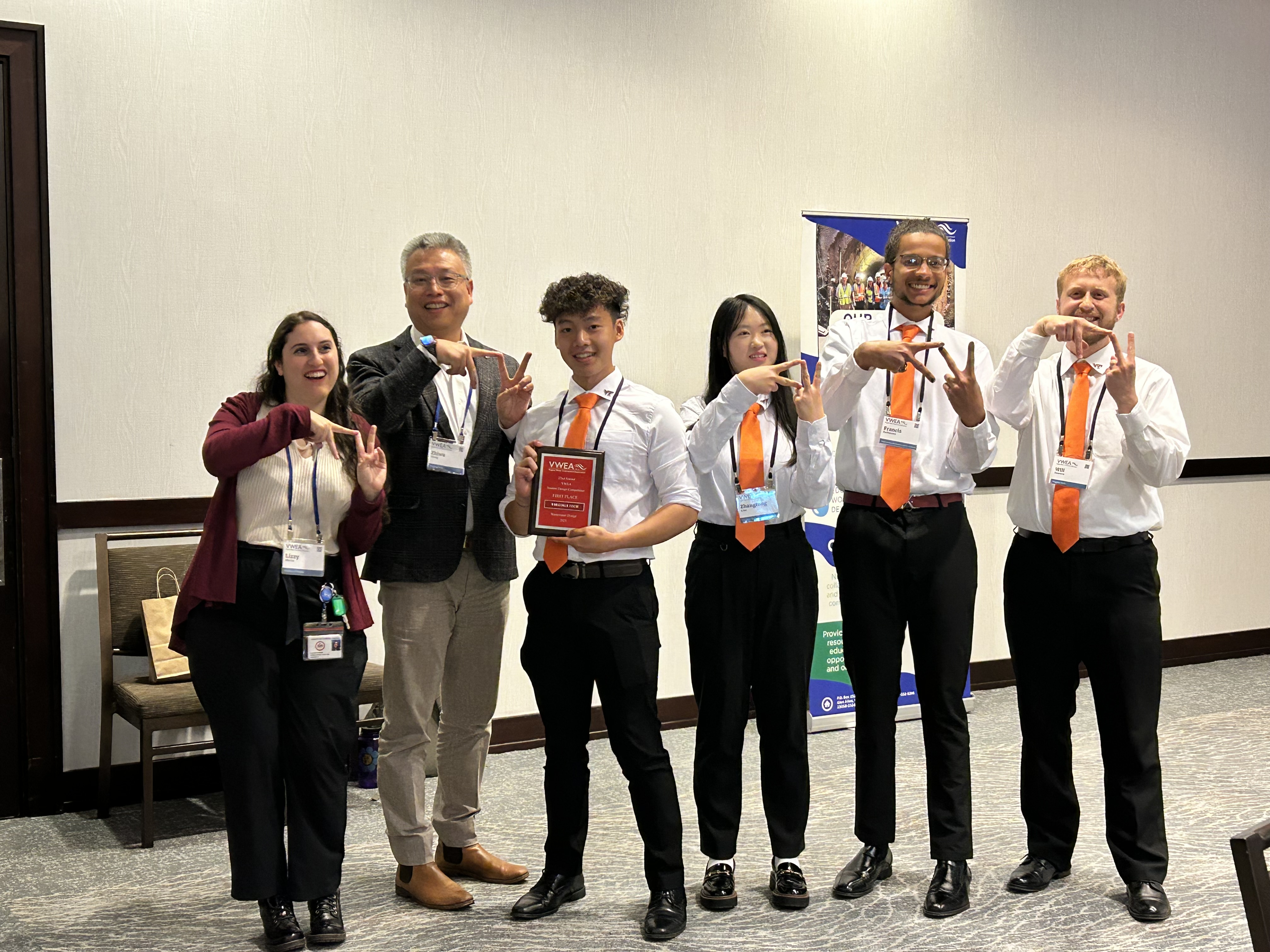
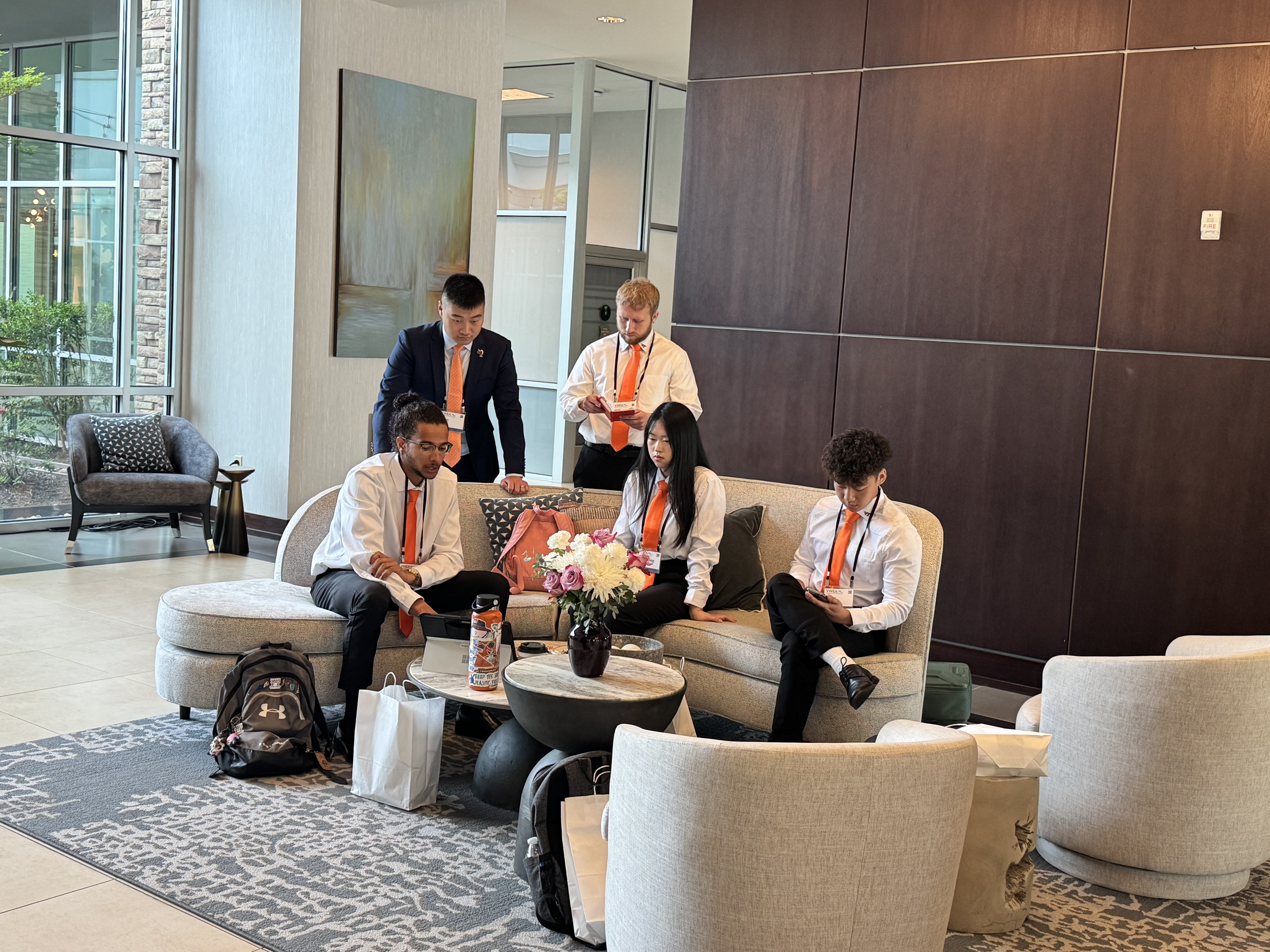
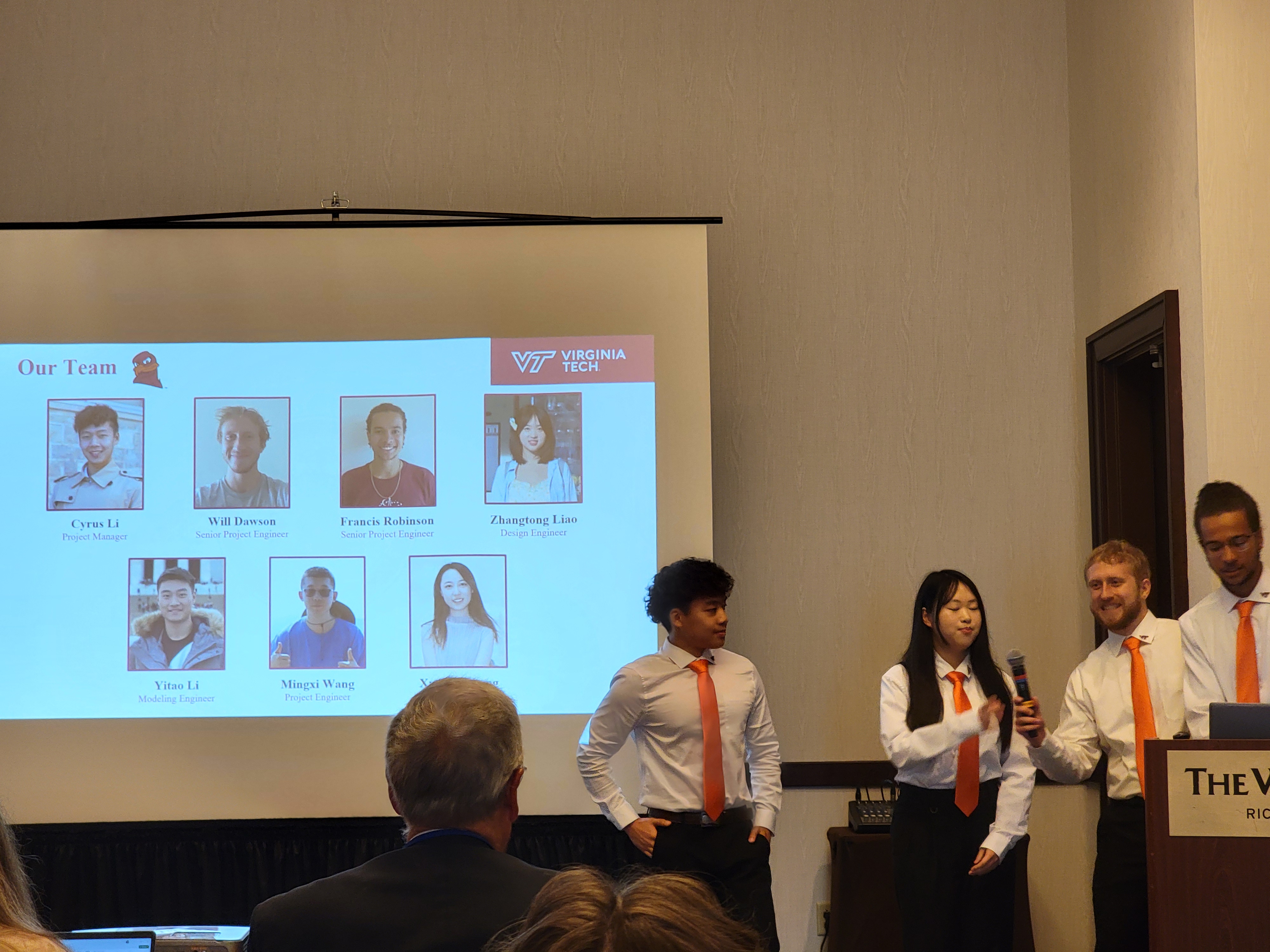
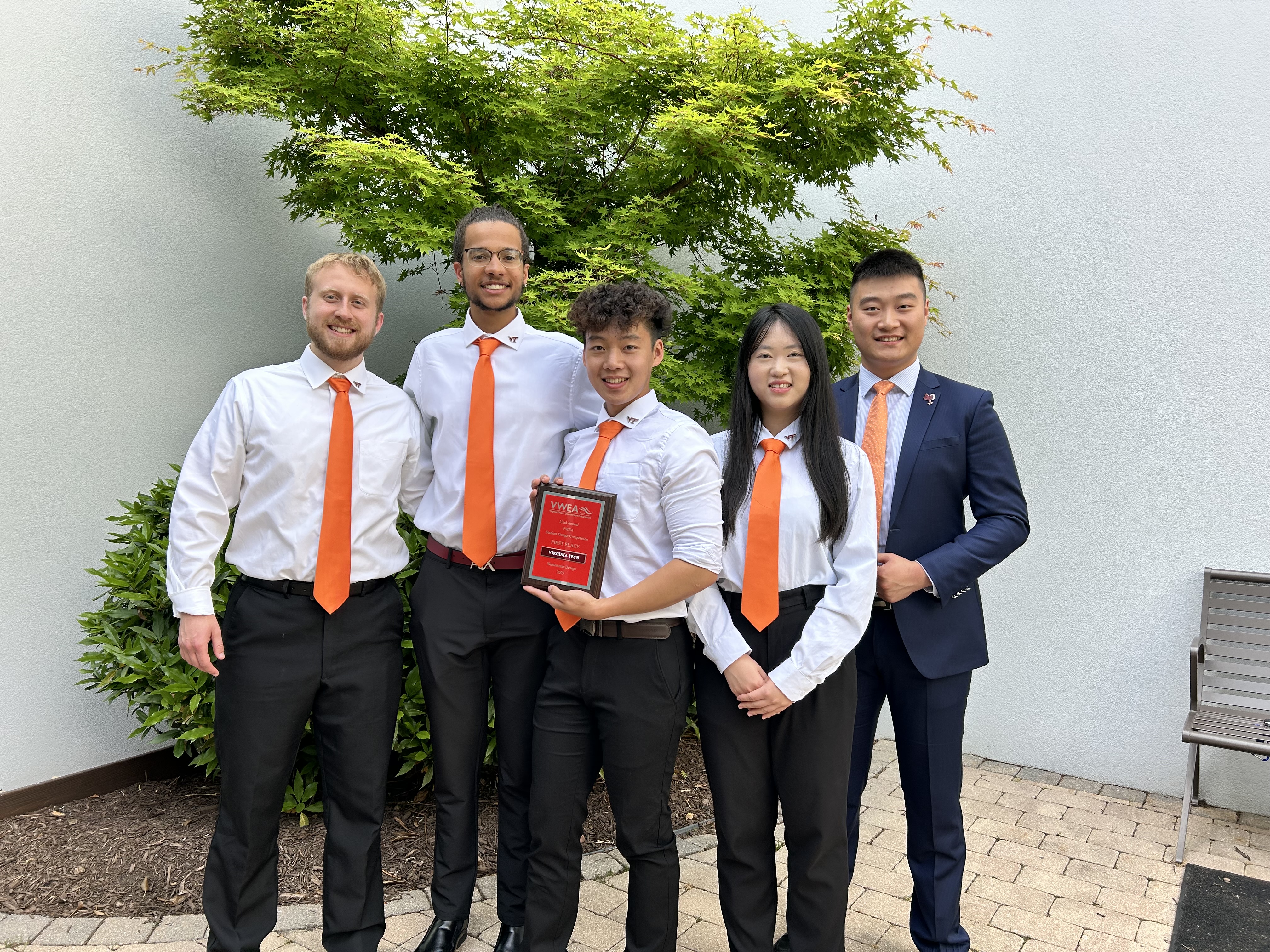
Congratulations to our team winning the 1st-place victory in the Wastewater Category in the 22nd Annual VWEA Student Design Competition!
Hi Folks,
I am thrilled to share some exciting news from the 2025 Virginia Water Environment Association (VWEA) Student Design Competition held last week! The Effluential Hokies team, representing Virginia Tech, with students from both our Civil and Environmental Engineering, and our Biological Systems Engineering program, claimed a first-place victory in the Wastewater Category with their exceptional project focused on the Chincoteague WWTP Improvements.
Virginia Tech’s Effluential Hokies team made of Cyrus Li, Yitao Li, Zhangtong Liao, Xueyao Zhang, and Mingxi Wang from Dr. Zhiwu Wang’s lab along with Francis Robinson and Will Dawson from Dr. Amy Prudent’s lab. The team was coached by Dr. John Novak.
By earning first place at the state level, the Viriginia Tech team has now earned the honor of representing Virginia at the Water Environment Federation’s (WEF) International Student Design Competition this October in Chicago. This international competition, held during WEFTEC—one of the world’s largest water quality conferences—brings together top student teams from across the globe to showcase their innovative solutions to pressing water challenges.
I wanted to make sure you saw the LinkedIn Post from VWEA Student Design – LinkedIn Post and were aware of our Hokie winners from the competition. Here’s a list of our students who are working under Professor Zhiwu Wang and Professor John Novak, who did an excellent job mentoring these students this past semester.
Students that make up the Effluential Hokie’s Wastewater Design Competition Team:
Cyrus Li, Zhangtong Liao, Will Dawson, Xueyao Zhang, Yitao Li, Francis Robinson, and Mingxi Wang
Ms. Elizabeth Merin, Engineer III, EIT, ENV SP in the Wastewater Design and Construction Division, Capital Facilities, DPWES, County of Fairfax.
Virginia’s Land Grant Universities Conduct Critical Research for the Next Generation
Virginia’s land grant universities were established to research and address local challenges and disseminate that information to the public. Virginia Tech and Virginia State University are doing just that as they conduct critical research for the next generation of farmers and consumers with cost-saving and environment-protecting solutions.
Farming Bioplastics
At Virginia Tech, Zhiwu “Drew” Wang, Ph.D., associate professor and Extension specialist, conducts groundbreaking research to convert food waste into items people use every day. According to Wang, nearly 40% of food produced in the U.S. ends up in landfills. This results not only in greenhouse gas emissions but also carries an annual $165 billion in economic loss from the food, water, energy and chemicals spent in the food supply chain. Additionally, 65% of plastic also finds its way to landfills.
“In the landfill, food converts into greenhouse gas, and plastic left to break down over time becomes microplastics,” Wang says. “These plastics will occupy the landfills for hundreds of years, and the microplastics released along with landfill leachate will eventually harm the environment.”
Wang and a team of researchers at Virginia Tech are conducting a three-year pilot study on bioplastics made from food waste. To create bioplastic, researchers utilize microorganisms to convert food waste into biopolymers – organic polymers produced by living organisms made from biomolecules like carbohydrates, proteins and fats – which then get processed into bioplastics.
“I farm lots of bacteria to eat the food waste, and the bacteria grows lots of ‘fat,’ namely biopolymers,” Wang says. “Next, I open the bacteria cell walls, and they release their fat and then I process or refine that bacterial fat into bioplastics.”
The outcome of this innovative project will be a process that delivers economically feasible bioplastic products made from food waste.
See more: Virginia’s Land Grant Universities Conduct Critical Research for the Next Generation